

The Substack Life Cycle, Reprise
Writing About Writing #8

Read More Writing About Writing
New To Gibberish? Check out Navigation for Newcomers!
Buy my eBooks: Shop Gibberish!
Lea este artículo en español, con agradecimiento a Roberto
This All Sounds Familiar
In June of 2023 when Substack Notes was 2 months old, I wrote a post speaking to The Discourse of That Time1, about the Substack Life Cycle. This post was, itself, a revisiting of the business concept called the Product Life Cycle but tuned to Substack.
The post will be 3 years old this summer, and is kind of a time-capsule of what Substack was like at the time. A lot has changed in the intervening years. A LOT has changed. But the way these cycles work remains the same.

I saw some comments recently about how the growth has slowed for some publications, and people are reaching for explanations. “The algorithm changed! Money hungry silicon valley elites are trying to maximize revenue!” some claim. Others look for solutions: “Time to go offsite and see if I can gather in more subscribers”.
The trouble with these perspectives is they aren’t acknowledging the existence of the life cycle. To my mind, they cannot see the problem, so will not find a solution2. They will get frustrated and disheartened and make decisions that hurt more than they help.
I don’t want that for any of you. I think we could all stand to learn from the Product Life Cycle, and my reinterpretation of it for Substack, because it can help you navigate the landscape of Substack as it changes and grows.
I am not offering anything new, anything original, or anything clickbaity. This post will never be paywalled, it is free for all and free to share, because this information helps all of us. I am going to spend some time setting up the discussion to facilitate deeper understanding, but if you want to skip to the practical bit you can click this link HERE to skip ahead.
The Substack Life Cycle Is Inevitable
The Substack Life Cycle is inevitable because the Product Life Cycle is inevitable; the Product Life Cycle is inevitable because this is how math works when selling products at scale.
Intuitively we all want growth to be exponential.
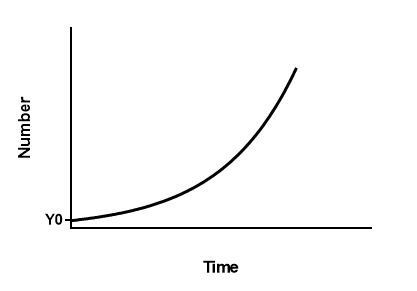
Exponential growth does not happen, and if it does it is anomalous. Exponential growth is what pyramid schemes are looking for. I bring you and a friend; you and a friend bring two more; each of them brings two more—in six steps of doubling you get 127 people involved in your scheme.
I will celebrate my 4 year anniversary on Substack this April; Notes will celebrate it’s 3 year anniversary this April, Substack is now in it’s 9th year of existence. We have some data about how subscriber behavior works. It looks more like a logarithmic scale:
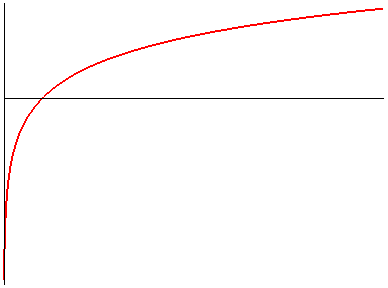
You will notice that, at the start, it looks kind of like an exponential curve, but each incremental tick yields diminishing growth. That is to say, growth tends to slow down. It will take more time and more effort to move up a logarithmic curve than it takes to move up an exponent curve. This is disappointing and disheartening when we come in guns blazing wanting things to go up all the time forever.
If you look at your ‘all time’ subscriber chart, you should see something that looks closer to this logarithmic pattern than the earlier exponential pattern. You will probably see this pattern repeating itself as bursts of new subscribers give way to boring old slogging growth.
I call this an inevitability. There is a twofold growth happening that affects newsletters on Substack. First: your own subscriber base is growing. If you imagine your current offering, and you freeze the platform at this moment of time, there is a theoretical maximum number of subscribers who are interested in that offering. As you approach that theoretical maximum, there are fewer remaining people left to be discovered.
The second of the twofold growth that is happening is that Substack itself is growing. As more and more newsletters start, it becomes harder and harder to stand out from the noise. If you freeze Substack at this moment in time, there is some theoretically finite pool of people who write about the same thing you write, and each of you are fighting over the theoretical maximum number of subscribers who are interested in that topic. If the pool increases, the number of possible subscribers decreases. The competition intensifies, growth slows.
This is all presuming no changes have been made to the algorithm, this is only mathematical reasoning. If anything else about the platform changes, the math changes slightly. Because the math is the same no matter what the platform does, you can safely ignore the platform.
This is the key of acknowledging the mathematical inevitability of progressively slower growth: if it affects everyone, it is not making the difference in your particular success or failure. Said another way: the thing standing between you and your wild success as a newsletter is NOT the business decisions made by the platform, it’s what decisions you make as you ride the life cycle3.
The Substack Life Cycle Is Predictable
Because the Substack Life Cycle is inevitable by mathematical logic, it is predictable. This should be a consolation to all of us newsletter writers—if it’s predictable, we can see it coming, we can prepare, we can strategize.
In fact, when I was in school for my MBA4, I learned that the Product Life Cycle was broken into discrete phases with unique strategies applicable to each phase. The phases are these: Introduction Phase: You have introduced a new product into the market and nobody knows what it is. Growth Phase: People have started to figure out that your product is awesome and growth is rapid. Maturity Phase: Growth slows down as your new product is now in every home. Decline Phase: Growth begins to decline because your product has become old news.
It doesn’t take that much effort to see how each of these phases applies to a newsletter. When more and more people begin to notice that growth is slowing down, they are declaring that they are entering Maturity Phase.
Let’s take a brief look at each phase and it’s application to Substack.
Introduction
This phase requires above all grit and persistence. You want to write something, nobody knows who you are, so you have to keep showing up and proving that you know what you are doing. This may involve some experimentation, some false starts, some innovative thinking—but the goal of the Introduction Phase is first to show up, second to land on some sustainable writing model that you can do for a long time.
Growth
This phase will seem to happen without any effort on your part, but it was set up in the previous phase. This is when you start to break through, people start to discover you. People like what you are doing—growth takes off. This phase feels exponential but is just the very beginning of the logarithmic curve we saw earlier. You don’t have to do much—just keep the ship running steady.
Maturity
This phase will begin to feel disappointing. The seemingly exponential highs of the Growth Phase wear off and suddenly its the long slog again. You’ve reached precipitous heights but—now what? You’re approaching that theoretical maximum number of interested subscribers. That is a good thing!5
Maturity phase can go one of two ways, and it will take a long, long time to get there. The first way is to do something new, and restart the cycle at the Introduction phase for that new thing. The second way is to ride out the phase, and let that theoretical maximum peak and then begin to decline as attrition, bit-rot, and natural changes in attitude move away from your newsletter. The Theoretical Maximum does not stay the same forever, and may go down. This enters the Decline phase.
Decline
This phase is the beginning of the end. You’re losing subscribers, there’s no real excitement, your newsletter is the same but just not generating the excitement it once did, and people are leaving for the next big thing. The option always exists to begin the cycle anew at the Introduction Phase by doing some new thing, or you can ride out into the sunset as a beloved and terminal newsletter.
The Substack Life Cycle Is A Cycle
Introduction Phase is where you go when you do something new and exciting and interesting. You go there immediately the second you do that new thing. It changes your offering, changes your theoretical maximum of interested subscribers, it generates interest.
The question, at some point, becomes when do you do this, not if.
You obviously don’t want to introduce too many new things at the same time, so you want to exit the Introduction phase, and have the patience to navigate through the Growth phase again too. The Maturity Phase can take a LONG TIME to resolve itself, so if you play the long game you can enjoy stable, steady growth (or if you are so blessed, income) as long as people remain interested in what you are currently offering. There’s no real urgency, maturity phase represents stability6. The urgency comes from wishing for that Exponential Growth.
You can wait a while through maturity and reconfigure your offering; or you can wait for things to start to decline and see what the landscape looks like then. The bottom line is that, eventually, if you want growth again, if you want different results than those offered by the maturity phase—you have to do something different7.
And, guess what—if you introduce that new thing, you will arrive at maturity again and have to think about this all over again. It’s a cycle, it will keep coming back.
The Substack Life Cycle Is Navigable
So now we can talk strategies. What are some things we can do to navigate this life cycle?
Expand the pool of subscribers: If you have a bigger pool, you have a bigger theoretical maximum. The more people who see your newsletter, the bigger the theoretical maximum is, and so the higher your growth will reach before you slide into maturity. This can be from offsite, from on-site, from IRL8. There are a lot of ways to do this. The core idea is to find people who won’t have heard of your newsletter before.
Deepen your offering: If you don’t make the pool bigger, you can make it deeper. Going deeper means offering more value to those existing subscribers, in a way that encourages them to stay and/or tell their friends. More people will seek you out because you offer the depth they are looking for.
Sharpen your offering: If you offer the same product only better, you can reinvigorate excitement about your newsletter.
Diversify your offering: If you are focusing on only the written word, what about video? If you are offering video, what about the written word? If you don’t include voiceover, what if you did? If you don’t use chat, maybe start? Substack offers more and more and more ways to diversify without ever leaving the site. It is worth seeing what you can do.
Change your price: A lot of times, growth slows because there is a mismatch between what you are offering and what you are asking for it. One person might buy a can of beans for $100, but if 200 people would buy a can of beans at $1 you are coming out better with the lower price. Do an honest assessment about what you’re asking for and what subscribers are getting.
Diversify your offering (again): Can you turn your newsletter into a book? Can you make a product you can put in peoples hands? Can you sell bumper stickers, mugs, other things offsite that would start leading people to your newsletter in meatspace?
Is Substack Dead?
No. No, if you are reading this because things have slowed down for you, you have reached the admirable and lofty heights of the Maturity phase. Substack isn’t dead—you have an opportunity now to decide what to do next. What makes Substack special is that they don’t promise anything other than giving us the power to make our own fortunes on this site. The future is not terminal if your growth has slowed down. It is time to choose your adventure!
Good luck out there!
AJPM
I don’t jump into discourse often but this one I can speak to
Some of the reflexes are correct but it only delays frustration without building a coherent strategy around what is actually happening on the ground.
With apologies to Queen
(derogatory)
If I had a nickel for every complaint I saw about slow growth from someone making a meaningful income from substack I’d be…okay well not THAT rich but richer than I am now.
This is good! I can’t impress upon you enough how a long and stable maturity phase is good!
IF 👏 YOU 👏 WANT 👏 SOMETHING 👏 DIFFERENT 👏 YOU 👏 MUST 👏 DO 👏 SOMETHING 👏 DIFFERENT 👏
Real life, not Ireland. Although—Ireland counts too if you aren’t being read there.
Good insight 😃. Can i translate part of this article into Spanish with links to you and a description of your newsletter?
Reading this in Ireland, so appreciate the IRL mention, and everything else in this piece. 😀